Death and the Fisher
Handling the UndeadDeath and the Fisher names two closely connected but not identical ideas: death as a force that gathers the human element from the dead, and the Fisher as a comprehensible image of that force. The figure changes across different people’s encounters, but its hooks recur as the sign of its collecting work. Eva’s childhood account and drawing make the Fisher vivid; Flora’s later understanding reveals why that vivid appearance cannot be taken as the force’s literal form.
A Force and Its Images
Death does not appear through one stable human shape. Peter’s vision gives it the form of a wolf: confronted on a road, the animal seems about to kill him, then turns and disappears into the forest. Flora recognizes that the image is not merely imaginative play when she understands that she herself is Death. Her own conception is Death as a twin sister, an idea that began years earlier when she tried, with a candle and a mirror, to summon the Dark Lady and saw only herself. The contrast matters: the wolf is death as an approaching threat, while the twin makes death intimate, inseparable from the self.
Flora’s recognition does not mean that Death is literally her double. After seeing what emerges from the burned bodies, she understands that the other Flora is only a force, one that takes a form each person can make sense of. Its task is to catch and collect; even the hooks that appear to define it are images rather than physical features of an otherwise human-shaped being. The twin likeness is therefore a translation, not an identity. It gives an incomprehensible force a shape, while the hooks make its function legible.
Eva’s Encounter with the Fisher
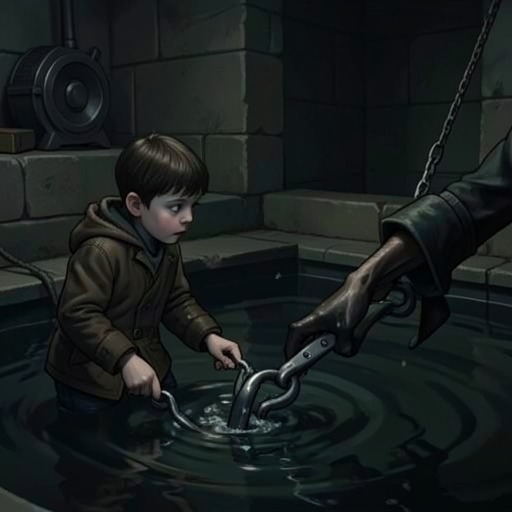
Eva’s image of the Fisher reaches back to her near-drowning as a child. Sture explains that, several days after the incident, she told her family that some kind of creature had been with her in the water. She called it the Fisher. As an adult, Eva had described the presence as the thing that had come to take her, connecting her childhood name to the threat she remembered.
Sture shows David a picture in Bruno the Beaver Finds His Way Home, pointing out the Waterman in the lake and explaining how the story recalled Eva’s experience. The childhood drawing gives that connection a more unsettling form. The girl in it is unmistakably happy, smiling with an expression that fills half her face, though the figure beside her is at least three times her size. It has no face, only an empty oval; its body and limbs are traced in wavering lines that suggest something changing or dissolving. Sture recalls that Eva said the creature was not clearly defined, as if it changed continually.
One detail in the drawing is sharper than the rest: the hands. Their fingers are carefully outlined, and each ends in a large hook stretched toward the smiling child. That contrast between an indistinct body and precise hooks anticipates Flora’s later account. The image is frightening not simply because the Fisher towers over the girl, but because it makes the creature’s purpose visible while leaving its nature uncertain. The child’s smile and the extended hooks occupy the same picture without explaining how Eva understood their coexistence.
Collection, Escape, and the Human Element
Flora’s encounter with the aftermath of the fire clarifies what the Fisher collects. White caterpillars emerge from the burned bodies; only seven appear, although around fifteen people had been present. Flora understands the caterpillars as the human element in those people, made visible in a form that can be comprehended. The body and the person are not treated as identical: when the bodies are destroyed, what has emerged has nowhere to go. Flora believes the others have been taken, while the caterpillars left behind are lost; as she watches, they swell and change from white toward pink and red.
This distinction gives the Fisher’s hooks a consequence beyond their appearance. The force gathers some souls, while others disappear by another route. When Eva’s body is failing, Flora communicates these two possibilities to her and urges her to let go. Eva resists because she wants to live, then asks for time to say goodbye. The Fisher is already approaching: it descends toward the glint of Eva’s emerging soul, ready to catch it.
Eva escapes before the Fisher can take shape and before her soul becomes its catch. She leaves her chest with a speed unavailable to a living body, brushes past Flora as a passing consciousness, and is gone; Eva’s body collapses at Flora’s feet. The Fisher then continues the chase. The ending preserves the distinction at the heart of the concept: death’s collecting power is real within the scene, but collection is not the only possible destination. The figure that first appeared in Eva’s childhood as a creature in the water becomes, in Flora’s understanding, one image of a force whose work can be perceived but not reduced to a human form.